
A small outdoor space still has room for a retreat. The move is to stop spreading plants across the floor and grow them up a wall instead. Freeing the ground that way leaves space for a chair, and a forgotten corner becomes a place you want to sit with a cup of coffee.
That is the thinking behind these compact garden nook ideas with vertical planters. Every setup below pairs a seat with a planter that climbs upward, so greenery surrounds you without stealing the square footage your feet and knees need.
A balcony, a slim patio, or a narrow strip by the back door is plenty. The planter handles the structure here, screening sightlines and softening bare walls so the spot reads like a small green room. Here are 12 ways to build one, each anchored by its own vertical planter and its own style of seat.

1. Living-Wall Bench Backdrop
Mount a modular green-wall panel on the wall right behind a corner bench, and the planter becomes the backrest you lean against. Your shoulders rest against a living sheet of ferns, pothos, and trailing ivy, while the bench keeps the floor it always would and the greenery fills the wall above and behind it.
Pick a panel system with built-in drainage trays so water runs down through the pockets and not onto the seat. Fill the upper rows with sun-and-drought-tolerant plants and keep thirstier ferns lower, since heat and moisture both rise. A panel about the width of the bench, mounted to start roughly 6 inches above the seat back, frames the seat without crowding anyone’s head.
2. Slatted Planter Privacy Screen
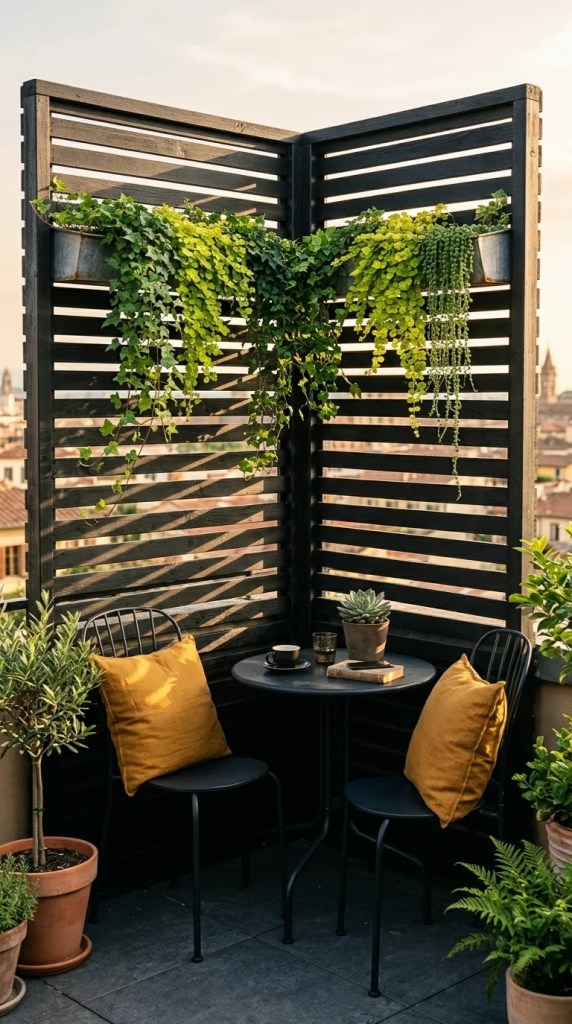
A freestanding slatted screen with a planter trough along its top edge does two jobs at once. It blocks the neighbor’s sightline and holds a row of cascading greenery overhead. Set two of them in an L around a two-chair bistro set, and the seating reads as a private outdoor room with its own green walls.
Because the screen stands on its own feet, it needs no drilling, which makes it friendly for a rented balcony or patio. Trailing plants like creeping jenny, ivy, or string of pearls work well up top, spilling down through the slats as they grow. Look for a base wide enough to stay upright in wind, or fix it to a railing with cable ties for extra hold.

3. Leaning Ladder Planter Lounge
Lean a wooden ladder planter against the wall beside one deep lounge chair, and its stepped rungs turn into a staircase of pots that climbs out of the chair’s footprint. The lowest tier sits at armrest height, so trailing stems brush your shoulder while the top tier draws the eye up and makes the whole setup feel taller.
This one suits a solo setup: a single chair with a side table and a throw. Stagger the pot sizes so each rung holds a different texture, with herbs near the bottom where you can reach them and leafy trailers up high. A five-rung ladder around 5 to 6 feet tall gives you enough planting tiers to wrap the seat in green while keeping its footprint to about a square foot of floor.

4. Pallet-Wall Hideaway Corner
Stand a planted pallet upright as a half-height divider, and you can slice a hidden pocket out of a larger patio. The open slats hold rows of herbs and flowers facing outward, while the seat tucks in behind it, screened from the rest of the yard. A bench or a floor cushion fits neatly in the sheltered gap.
Line the back of each slat with landscape fabric so soil stays put and water drains through cleanly. A standard pallet stands about 48 inches tall and 40 inches wide, enough to hide a seated person from the chest down and define the nook without walling it off completely. Sand the wood and seal it first so it lasts more than a single season outdoors.

5. Stacked Gutter Herb Perch
Mount three or four lengths of rain gutter in a stack up a sunny wall, cap the ends, drill drainage holes, and you have a vertical herb garden that floats above the floor entirely. Hang it over a fold-down wall ledge with a stool beneath, and it works as a place to perch with a coffee while you snip basil and mint within arm’s reach.
Shallow gutters suit plants with small root systems, so lean toward leafy greens, strawberries, and cut-and-come-again herbs over deep-rooted vegetables. Space the rows about 10 to 12 inches apart vertically so taller herbs have headroom and each channel still catches light. A drip tray or a saucer on the lowest run keeps watering-day runoff off the stool below.

6. Glowing Hydroponic Tower Spot
A vertical hydroponic tower grows plants in stacked cups around a central column, with water circulating up from a reservoir at the base, so it needs no soil and almost no floor. Set it as the centerpiece of the seating with two stools or a curved bench around it, and at dusk the soft glow of its grow light turns the nook into a quiet, sensory retreat.
These towers shine for leafy greens, herbs, and strawberries. Many run on full-spectrum LEDs, so a shaded balcony with under four hours of direct sun can still grow a harvest. A tower with a 20-gallon reservoir usually holds enough water to run for several days between top-ups. Route the pump’s cord to a weatherproof outdoor outlet and tuck the reservoir base behind the seating so the column reads as a green sculpture.

7. Hanging Pocket Swing Cocoon
Hang two fabric pocket panels on the walls flanking a suspended egg or hammock chair, and the seat ends up wrapped in green on three sides. Each felt pocket holds a small-rooted plant, so ivy, ferns, and pothos trail down around the swing and turn it into a leafy cocoon you sink into.
The chair itself takes no floor, since it hangs from a single ceiling hook or a standalone frame. Use a hook rated for at least 250 pounds and bolted into a beam, not into drywall alone, so the swing holds you safely. A string of warm lights woven along the top of the panels gives the cocoon a gentle wash of light once the sun drops.

8. Railing-Box Balcony Banquette
Run a deep planter box along the top of your balcony railing and set a low cushioned bench against the rail beneath it, and you sit under a ribbon of blooms with the open view in front of you. The planter rides the railing you already have, so it claims no floor, and the bench tucks into the few inches between the rail and the wall.
Pick a box with a self-watering reservoir, because a sunny railing dries fast and a built-in supply cuts watering to once or twice a week. Sun-loving trailing plants like geraniums, petunias, and nasturtium spill over the edge and screen the view of the street below. Check that your railing and bench can carry the load first, since many balconies are built to hold around 40 to 60 pounds per square foot and wet soil adds up fast.

9. Crate-Stack Floor Cushion Lounge
Stack two or three wooden crates on their sides beside a cluster of floor cushions, and the tower works double duty as a green wall and a side table for your drink. Plant the open tops with trailing succulents and herbs, leave the cubbies below for a book or a lantern, and the deck corner turns into a low, ground-level nook.
Two or three crates reach side-table height, around 24 to 30 inches, which keeps the planting within reach when you are seated on the floor. Succulents like sedum and echeveria suit the shallow crate depth and shrug off the odd missed watering. Drape a strand of warm bulbs along the stack, toss down a flat weave rug, and pull in a few rustic garden accents to set the lounge apart from the rest of the deck.

10. Spiral Plant-Stand Reading Curl
A spiral plant stand winds a column of pots upward in a tight coil, so a dozen plants share a footprint about 18 inches across. Curl it into the angle of the wall beside a single reading chair, and the greenery climbs like a green column framing the seat without leaning over your book.
That tight base is why this one fits a balcony with no room to spare. Mix trailing plants, upright herbs, and a few succulents up the coil so the textures change as your eye travels the spiral. Position the tallest pots at the back of the curve so nothing blocks the light reaching the chair.

11. Grid-Panel Fold-Down Café Wall
Fix a metal grid panel to the wall, clip small pots across it in any arrangement you like, and mount a fold-down café table for two right below. Flip the table up when you want to eat, and fold it flat the rest of the time, leaving the grid of greenery as the only thing on show. Two folding chairs slide away against the wall between meals.
Because the pots clip on and off, you can swap plants by the season or rotate them toward the light. Herbs, small foliage plants, and air plants all suit the shallow grid, and air plants need no soil at all, which keeps the panel light on its anchors. Slide a narrow drip tray under the bottom row so watering does not spot the table below.

12. Stacked Window-Box Sun Seat
Stack two or three window boxes up a sunny stretch of wall on staggered brackets, and the climbing rows of flowers turn the wall into a vertical garden above a built-in window seat. The seat runs along the base of the wall, soaking up the same full sun the boxes love, so it doubles as the warmest perch in the yard on a cool morning.
Plants that crave light belong here: lavender, trailing geraniums, and rosemary all reward a wall that gets 6 to 8 hours of sun. Choose window boxes with a self-watering base or a saucer rail, since a wall in full sun drains fast on a hot afternoon. Anchor the brackets into studs, because a wet window box can weigh upward of 30 pounds once the soil is soaked.
Send Your Garden Upward
The thread running through all 12 setups is the same: send the plants upward, and the floor stays open for you. A living wall, a railing box, or a spiral stand each lifts the planting off the ground and turns a tight corner into a small garden nook worth sitting in.
Start with the seat you already want to use, then choose the vertical planter that frames it best for your light and your space. One panel of pockets or a single stack of crates is enough to begin. The green room grows from there.
Frequently Asked Questions
What exactly is a garden nook?
A garden nook is a small, set-apart area in an outdoor space built for sitting and unwinding. It usually holds one or two seats wrapped in greenery, with enough enclosure that the corner feels separate from the rest of the yard. Think of it as a private pocket you return to for a coffee, a book, or a few quiet minutes.
How do vertical planters save space in a small garden?
Vertical planters grow plants upward on a wall, railing, or freestanding frame, so the greenery climbs into space that would otherwise sit empty. The floor stays open for a chair or a small table. A single wall of pockets can hold 20 or more plants in the footprint one large floor pot would take.
What plants work best in a vertical planter nook?
Shallow-rooted plants do best, since most vertical systems hold limited soil. Herbs like basil, mint, and thyme thrive in pockets and rail boxes, while trailing plants like pothos, ivy, and string of pearls spill down to soften the edges. For a sunny spot, succulents such as sedum and echeveria handle the heat and need little water.
How do I make a small garden nook feel private?
Wrap the seat in greenery on two or three sides so it feels held and screened. A freestanding slatted screen, a tall pallet planter, or a living wall blocks sightlines while adding plants at the same time. Even a single vertical panel placed where the neighbor’s view lands turns an open seat into a screened retreat.
How much sun does a vertical planter nook need?
It depends on what you want to grow. Flowering plants and sun-loving herbs like rosemary and lavender want 6 to 8 hours of direct sun a day, so place those boxes on your brightest wall. For a shaded balcony with under 4 hours of sun, lean on ferns, pothos, and shade-tolerant herbs like parsley and cilantro, or use a hydroponic tower with grow lights that works in low light.
How do I water a vertical planter so it doesn’t drip onto the floor or a neighbor below?
Choose systems with built-in drainage trays or a self-watering reservoir, which catch runoff before it reaches the ground. Slip a saucer under the lowest row of pots or the bottom gutter to catch the last of the overflow. On a balcony, water slowly and in smaller amounts so the soil absorbs most of it before any can run through onto the rail or the floor below.
Which vertical planter is best if I rent and can’t drill into the wall?
Stick to freestanding and clip-on options that need no holes in the wall. A standing slatted planter screen, a spiral plant stand, or a ladder planter all hold themselves up on the floor, while railing planters and hanging baskets hook over the rail without a single screw. Tension-rod shelving and over-the-rail pocket panels also add vertical space and lift off cleanly when you move out.


