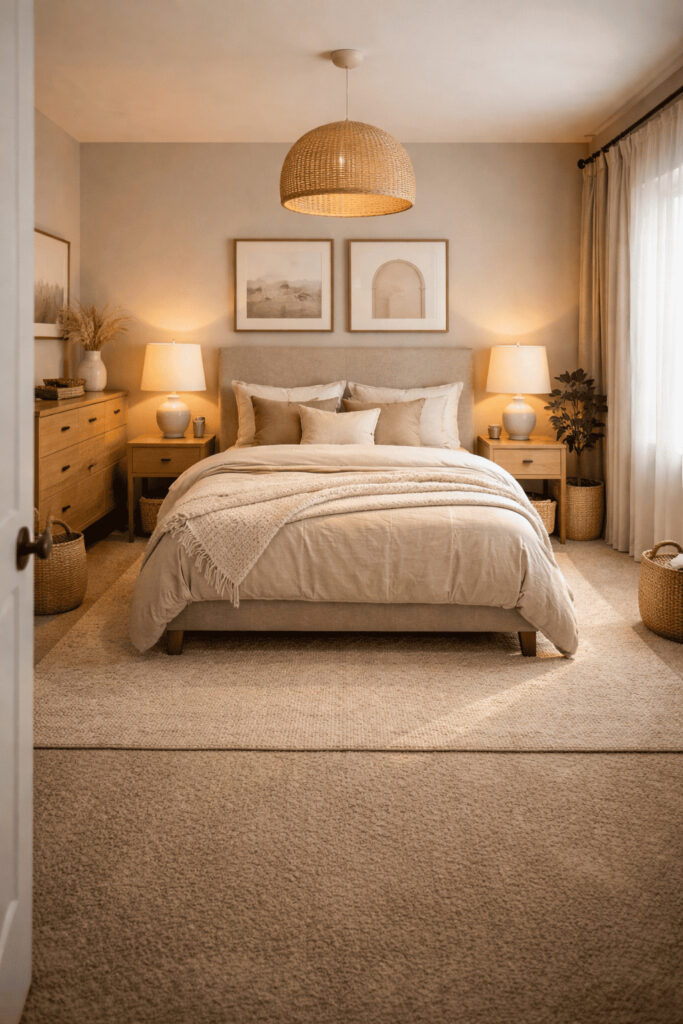
This is a blog about Tiny Bedroom Design Ideas
You moved into your apartment, excited about the location, the price, and the vibe of the neighborhood, and then you walked into the bedroom. A narrow rectangle of a room that barely fits your bed, let alone your dresser, your laundry basket, and the reading nook you’ve been dreaming about on Pinterest. Sound familiar?
If you’re renting a studio or a one-bedroom apartment in the city, you already know the struggle. Your bedroom isn’t just a place to sleep; it has to do a lot of heavy lifting. It’s your sanctuary after a long commute, your Sunday morning retreat, and sometimes your only real personal space in the entire unit. But here’s the truth that most renters don’t realize until they’ve tried and failed: a small bedroom isn’t a design limitation. It’s a design challenge, and challenges have solutions.
The ideas in this article aren’t just aesthetic tips. They’re practical, renter-friendly strategies that work in real apartments with real square footage restrictions. Whether your room is a narrow shoebox or an awkward L-shape with one sad closet, you’re about to see it differently. By the time you finish reading, you’ll have a clear game plan for turning your tiny bedroom into a space that actually feels livable, intentional, and honestly, worth showing off.
Let’s get into it.
Smart Layout for Small Bedrooms
Before you buy a single piece of furniture or roll out a rug, you need to think about layout, because in a small bedroom, the way you arrange things matters more than almost anything else.
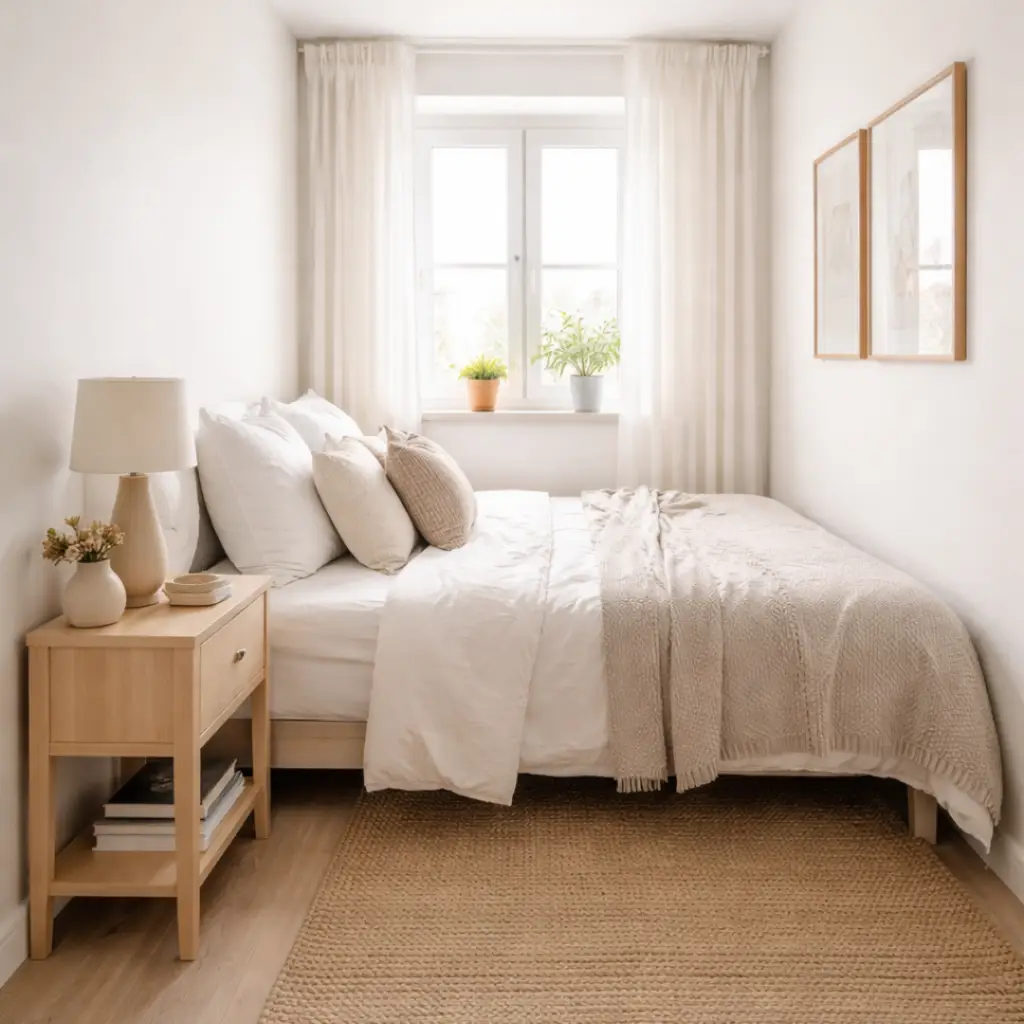
The single most impactful move you can make? Place your bed against the longest wall. This is the foundation of every smart small-bedroom layout. Pushing the bed flush against the longest wall immediately frees up the center of the room, giving you breathing room and making the space feel more open the moment you walk in. It also creates a natural anchor for the rest of your layout, so everything else has a logical place to fall.
Once your bed is positioned, your next priority is keeping walkways clear. In a small room, even 18 to 24 inches of clear floor space along your main pathway makes a dramatic difference in how the room feels to move through. Furniture that blocks natural traffic flow makes a room feel claustrophobic even when the dimensions aren’t that bad. When in doubt, choose function over symmetry. A bedside table on only one side of the bed is far better than two tables that force you to squeeze past them every morning.
As for floating furniture away from the walls, the design advice you’ve probably seen on every home makeover show only does this when space truly allows. In a genuinely tiny bedroom, floating your bed or dresser in the middle of the room just eats up the floor space you desperately need. Save that trick for rooms that have at least a little square footage to spare. In your apartment bedroom, walls are your friends.
Light and Neutral Color Palette
Color does something powerful in a small room , it either opens it up or shuts it down. And if your bedroom already feels like it’s closing in on you, the last thing you want is a paint color that makes it feel smaller.
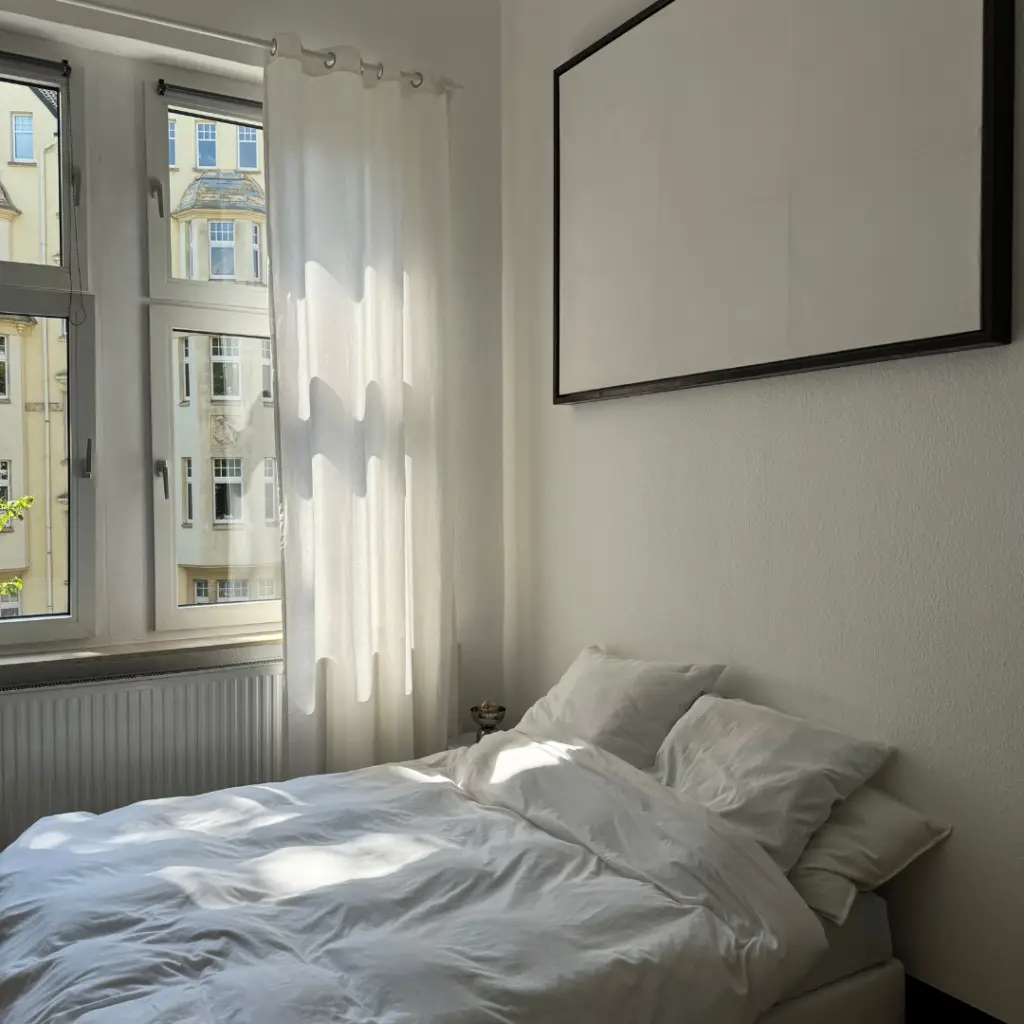
The safest and most effective approach for a tiny bedroom is to lean into whites, creams, and soft grays. These tones reflect light instead of absorbing it, which makes your walls feel like they’re pushing outward rather than caving in. A warm white or a soft greige (that perfect gray-beige hybrid) on your walls can make a noticeably small room feel airy and calm almost instantly.
Here’s a trick that interior designers use that most renters never think about: paint your walls and trim in similar tones. When the trim is a stark white against a colored wall, it creates a hard visual boundary that actually emphasizes how small the room is. When walls and trim are close in value, the eye travels smoothly across the surfaces without stopping, which creates a sense of continuous, uninterrupted space.
And one thing to be mindful of: avoid heavy contrast. A dark accent wall, a bold patterned wallpaper, or deeply saturated colors can work beautifully in larger rooms, but in a tiny bedroom they tend to draw the walls inward and make the ceiling feel lower. If you love color, and there’s nothing wrong with that, bring it in through your bedding, artwork, and accessories rather than your walls. That way you get the personality without sacrificing the perceived space.
Renter tip: If your landlord requires you to keep the walls the original color, focus your neutral palette on your bedding, curtains, and furniture. The same principles apply , keeping everything in a cohesive light palette will still open up the room significantly.
Multifunctional Furniture Choices
In a tiny apartment bedroom, every piece of furniture needs to earn its place, and ideally, it should earn it twice. If something only does one job, you have to ask yourself seriously whether it deserves the floor space it’s taking up.
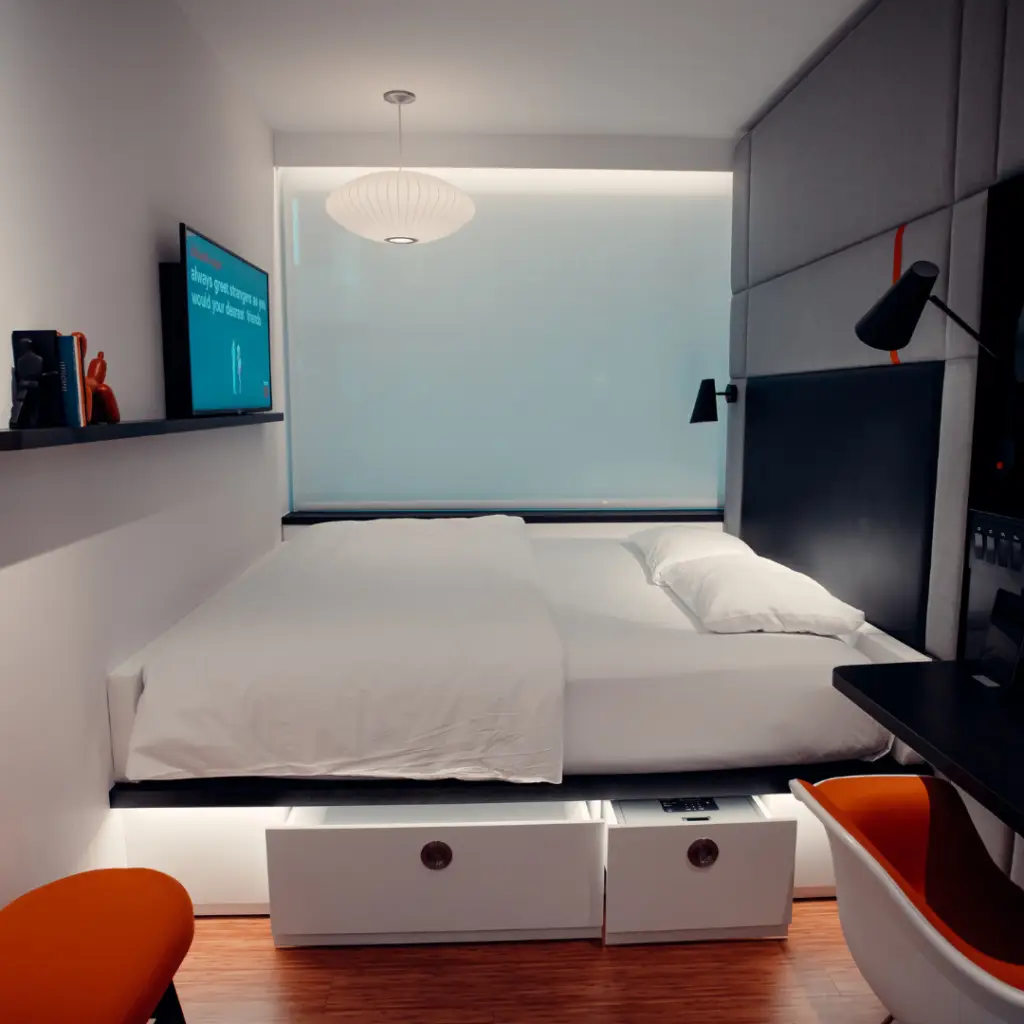
Storage beds are the single best investment you can make in a small bedroom. A bed with built-in drawers underneath or a hydraulic lift frame that reveals a deep storage cavity essentially gives you an entire extra dresser, without using a single extra square foot of floor space. For renters who are working with one small closet and no additional storage, this is a game-changer. You can store off-season clothing, extra bedding, shoes, and bulky items that would otherwise end up stacked in corners or crammed under the bed in a disorganized pile.
If your bedroom needs to double as a workspace, which is increasingly the reality for urban renters, a foldable desk is one of the smartest additions you can make. Wall-mounted fold-down desks in particular are brilliant for small rooms because they disappear completely when you’re not using them. You get a real, functional workspace when you need it, and you get your floor space back when you don’t. Some even come with built-in shelving above, so your workspace does triple duty.
Don’t overlook the ottoman with hidden storage either. At the foot of your bed or in a small corner, a storage ottoman works as a seat, a surface for folding laundry, a footrest, and a storage bin all at once. It’s one of those pieces that guests never notice is doing so much work, which is exactly the point.
Wall-Mounted Storage Solutions
The moment you start thinking vertically instead of horizontally, small bedroom design clicks into place in a completely new way. Your walls are essentially unused real estate in most apartments, and wall-mounted storage lets you reclaim that space without touching the floor at all.
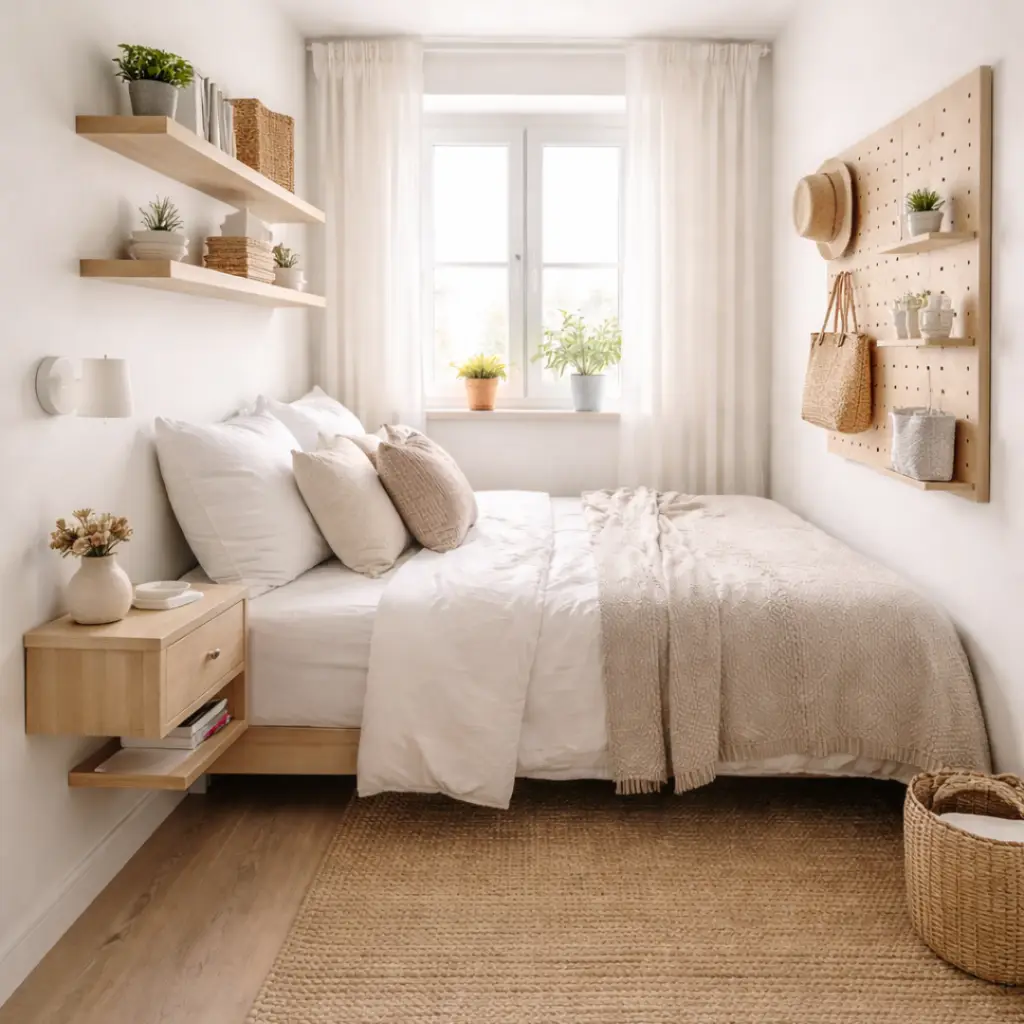
Floating shelves are the most versatile wall-mounted storage option available, and they work in almost any bedroom layout. Above your desk, beside your bed, flanking a window, floating shelves give you a place to store and display things without adding a single piece of furniture to the floor. In a tiny bedroom, even one or two well-placed shelves can eliminate the need for a bookcase or a second nightstand.
Speaking of nightstands, wall-mounted nightstands are one of the most underrated upgrades in small bedroom design. Traditional nightstands sit on the floor and take up precious square footage on either side of the bed. A wall-mounted shelf or bracket-style nightstand gives you the same functionality , a place for your lamp, your phone, your book, while keeping the floor completely clear underneath. That strip of visible floor makes the room feel more open and easier to clean.
For anyone who has ever stared at a cluttered wall in their bedroom and wished there was a better system, pegboards are worth serious consideration. What started as a garage organization tool has become a genuinely stylish and functional wall storage solution for bedrooms. You can hang accessories, jewelry, small baskets, hooks for bags, and even small shelves, all customizable and rearrangeable without putting new holes in the wall every time you change your mind. For renters who want flexibility, a large pegboard panel is one installation that does the work of many.
Under-Bed Storage Optimization
If your bed isn’t actively storing things for you, you’re leaving some of the most valuable real estate in your tiny bedroom completely unused. The space beneath your bed, even just 8 to 12 inches of clearance, is storage that costs you nothing extra in floor space.
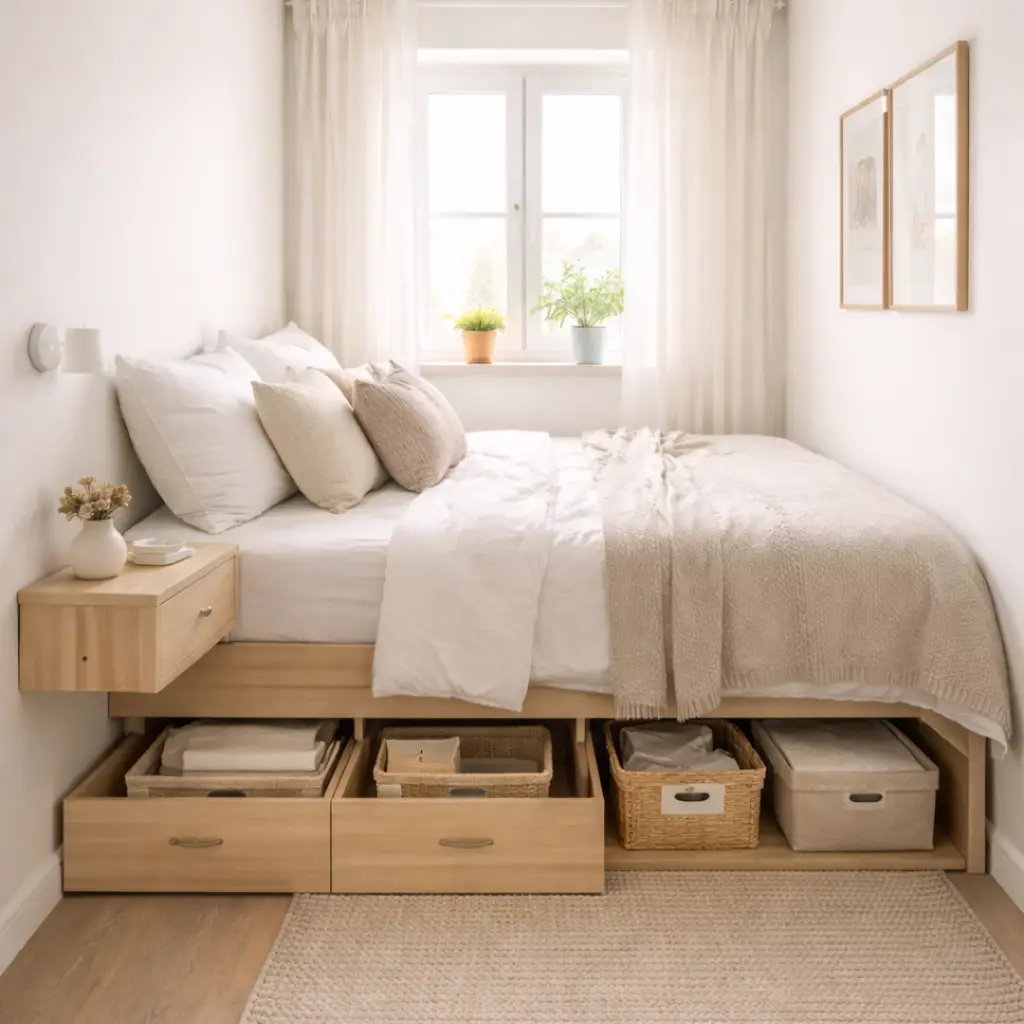
The most seamless solution is a bed frame with built-in drawers. These look intentional, stay organized, and keep everything hidden from view. No bins sliding out, no boxes visible from across the room just clean lines and hidden storage. If you’re shopping for a new bed frame, this feature alone should be near the top of your list.
If you’re working with an existing bed frame, slim, low-profile storage boxes designed specifically for under-bed use are your next best option. They’re available in everything from basic plastic to linen-covered styles that look polished even when the bed skirt pulls back. They’re ideal for shoes, folded sweaters, extra linens, or anything else you need access to occasionally but don’t want taking up closet space.
For items you only need a couple of times a year , heavy winter coats, thick blankets, bulky sweaters, and acuum-sealed storage bag are nothing short of miraculous. A comforter that normally fills an entire shelf compresses down to the thickness of a large book. Under your bed, you could realistically store an entire season’s worth of clothing in vacuum bags and never feel the space crunch. It takes a few minutes to set up but pays off enormously in closet and drawer space throughout the year.
Mirrors to Create Depth
There is a reason every small-space design guide, every interior design professional, and every before-and-after makeover show reaches for mirrors as one of the first solutions in a tiny room. It’s not a gimmick, it genuinely works, and the science behind it is straightforward: mirrors reflect light and reflect space, tricking the eye into perceiving the room as larger than it actually is.
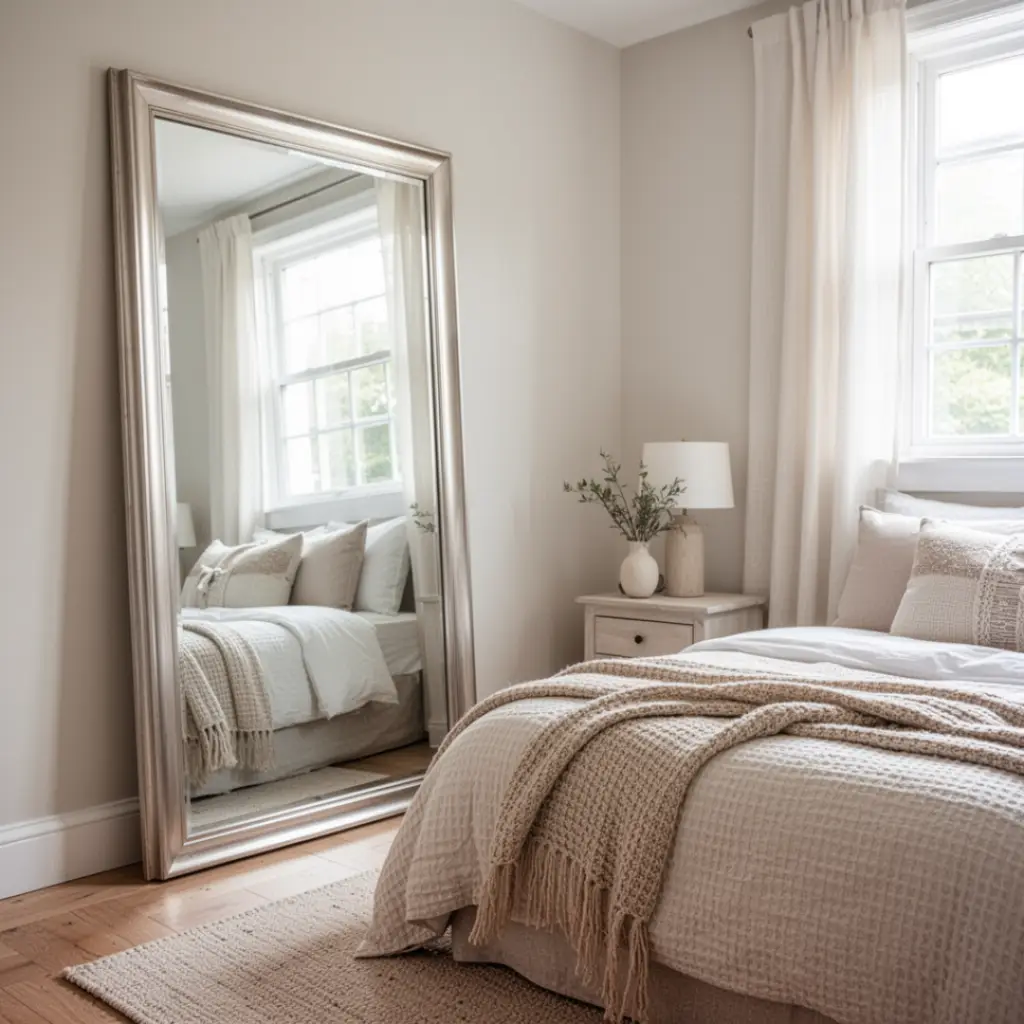
A full-length mirror is one of the highest-impact, lowest-cost additions you can bring into a small bedroom. Leaned against a wall or mounted behind a door, a full-length mirror instantly creates the visual impression of a second room beyond it. It also serves the obvious practical function, which means it earns its floor space in two different ways.
If your bedroom has a closet, consider upgrading to mirrored closet doors. This single change can transform the entire feel of a small bedroom. Instead of a flat, visually heavy door that stops the eye, a mirrored door extends the perceived depth of the room and bounces light around in a way that makes the entire space feel brighter and more expansive. Many apartment closets come with plain sliding doors that are easy to swap out, nd it’s one of the more impactful changes a renter can make.
The most strategic mirror placement of all is opposite a window. When a mirror faces a natural light source, it doesn’t just reflect the room , it reflects the light itself, essentially doubling the brightness in the space. In a small, potentially dark bedroom, this can be genuinely transformative. Even a small decorative mirror placed intentionally across from your only window will make a noticeable difference in how light and airy the room feels throughout the day.
Vertical Space Utilization
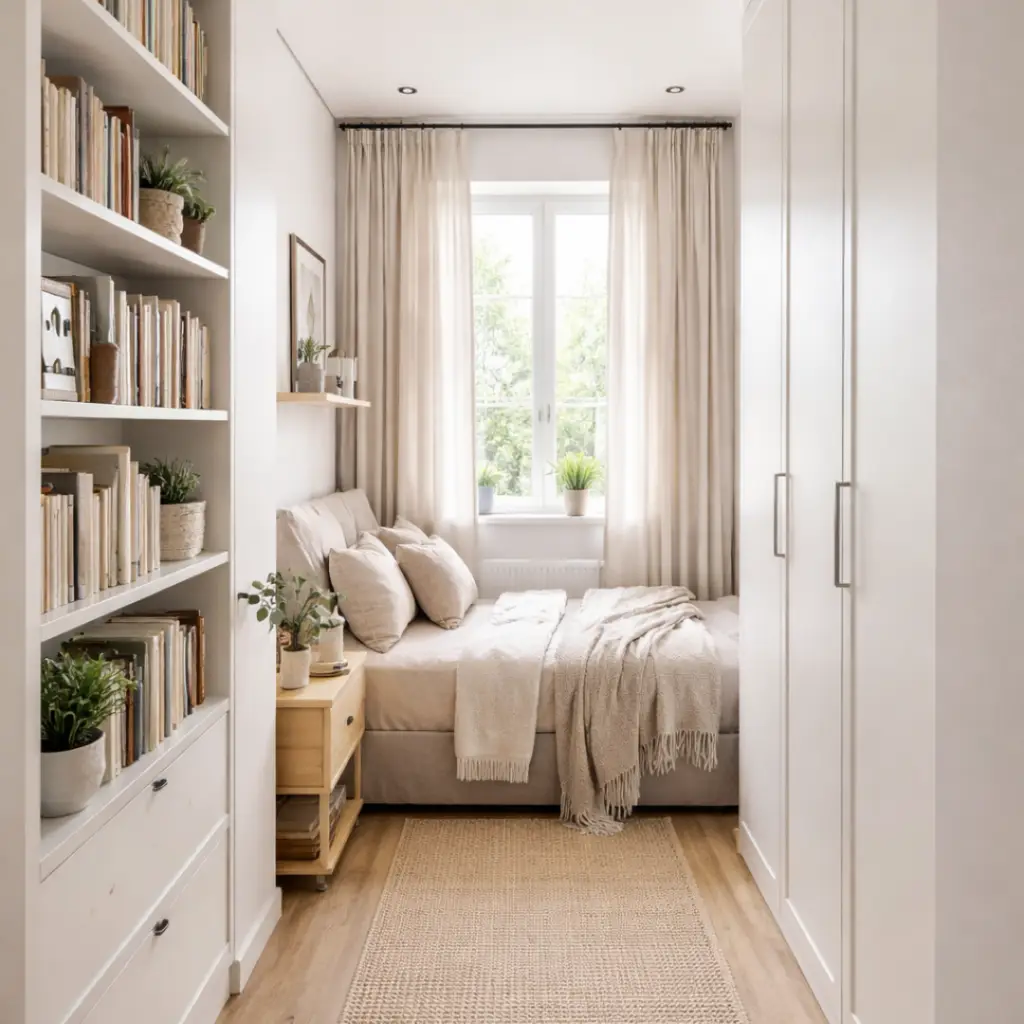
Most renters think about their bedroom in two dimensions, the floor plan. But in a small space, the third dimension, height, is where the real opportunity lives. Your ceiling is probably 8 to 9 feet up. Are you using any of that space? If not, you’re missing a significant storage and design opportunity.
Floor-to-ceiling shelving is one of the most dramatic and effective ways to maximize a small bedroom. Whether it’s a built-in unit or a freestanding tall bookcase pushed flush against the wall, shelving that travels all the way up to the ceiling draws the eye upward, makes the room feel taller, and gives you an enormous amount of storage that doesn’t cost you a single additional square foot of floor space. Style the upper shelves with things you don’t need every day, books, baskets, decorative objects, and keep the lower shelves for everyday items within easy reach.
Tall wardrobes follow the same logic. A wardrobe that reaches close to the ceiling gives you significantly more hanging and shelf space than a standard-height unit, and the vertical line it creates actually makes the room feel more spacious, not more cramped. In an apartment with limited or awkward closet space, a tall wardrobe can be a complete solution.
And here’s a curtain trick that costs almost nothing but makes a real visual difference: hang your curtain rods as close to the ceiling as possible, even if your window is much lower. Curtains that fall from ceiling height to floor draw the eye upward and create the impression of much taller windows , and by extension, a much taller, more spacious room. It’s one of those small changes that designers swear by, and once you see it in your own space, you’ll wonder why you didn’t do it sooner.
Minimalist Styling Approach
Here’s something that no furniture purchase or storage solution can fix on its own: a cluttered room will always feel small, no matter how well it’s laid out. In a tiny bedroom, minimalism isn’t just an aesthetic preference; it’s a functional necessity. And the good news is that you don’t have to become a hardcore minimalist who owns twelve possessions to make it work. You just have to be intentional.
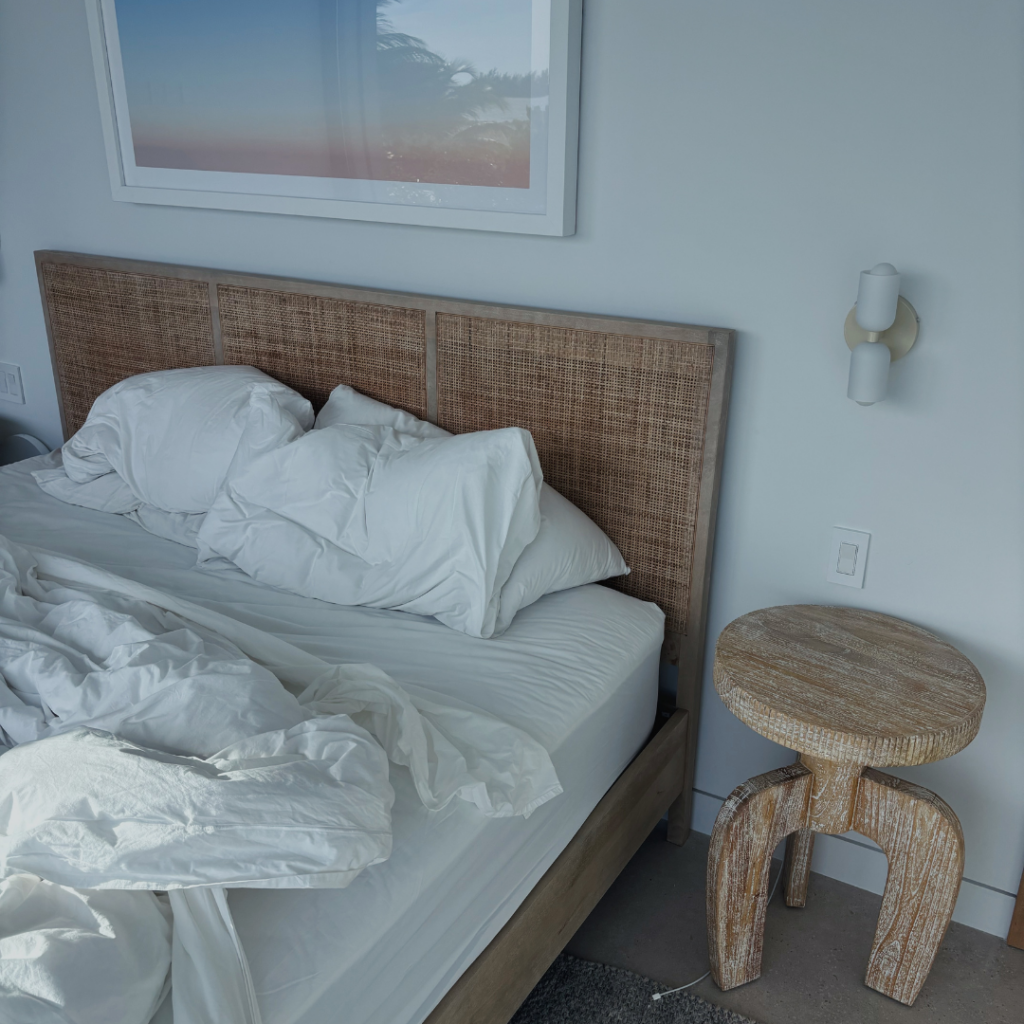
Start by making a firm decision to limit decorative objects. This doesn’t mean stripping your room of personality; it means being selective. Instead of fifteen small decorative items scattered across every surface, choose three or four that you genuinely love and give them room to breathe. A single piece of meaningful art, one beautiful plant, a candle you actually burn, these things add character without adding visual noise. In a small bedroom, less really does feel like more.
Keep surfaces clear. Your dresser top, your windowsill, your nightstand, every flat surface in a small room is a potential clutter magnet, and clutter shrinks a space faster than almost anything else. Make it a habit to keep these surfaces intentionally bare or nearly bare. If something doesn’t have a designated home off the surface, it either needs a home created for it or it needs to leave the room entirely.
When shopping for new pieces, choose streamlined furniture with clean lines and simple silhouettes. Ornate, heavily detailed furniture , carved wood frames, elaborate headboards, fand urniture with lots of visual texture , can feel overwhelming in a small space. Furniture with straight lines, simple shapes, and a cohesive finish keeps the room feeling calm and uncluttered even when it’s fully furnished. Think of it this way: in a small bedroom, the furniture itself is part of the décor, so every piece should be something you’d be happy to look at without anything on top of it.
Built-In or Custom Storage
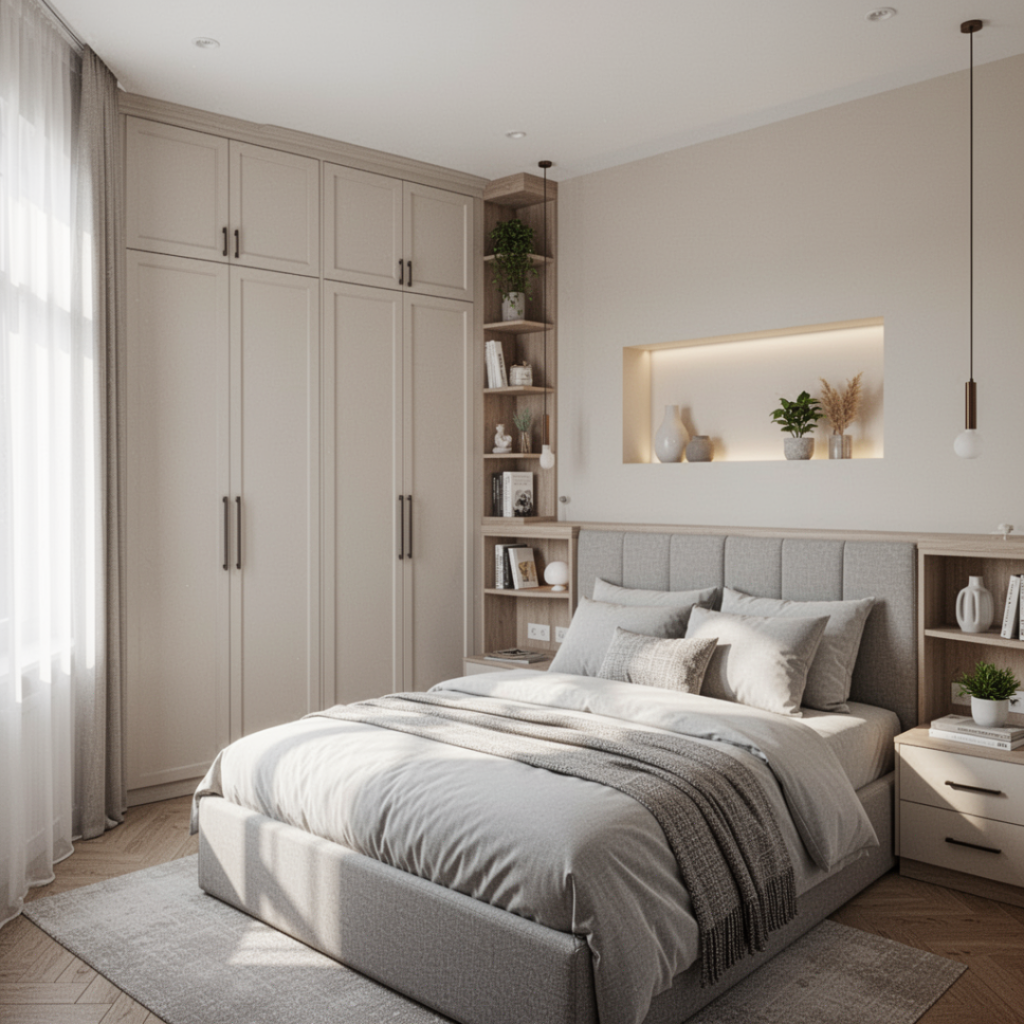
If there’s one area worth investing a little more thought, and possibly a little more budget , in a small bedroom, it’s storage that’s built specifically for your space. Generic furniture is designed for average rooms. Built-in or custom storage is designed for your room, which means it fits better, functions better, and almost always looks better.
Fitted wardrobes are the gold standard of small bedroom storage. Unlike freestanding wardrobes that leave gaps above, beside, and behind them, a fitted wardrobe goes wall to wall and floor to ceiling, capturing every available inch. The result is a storage system that feels like it was always meant to be there , because it was built to be. For renters, this might mean working with a closet organizer system that installs without permanent changes, but the principle is the same: maximize the entire cavity of your storage space, not just the parts a standard rod and shelf happen to reach.
A headboard with built-in storage is another brilliant solution that most apartment renters walk right past in furniture stores. A headboard with shelving, cubbies, or even hidden compartments behind it turns the wall behind your bed, typically dead space , into functional storage. You can keep books, charging cables, a small lamp, a glass of water, and other bedside essentials all contained within the headboard itself, freeing up your nightstand surface completely.
For a more architectural solution, recessed wall niches, small alcoves built or carved into the wall , serve as built-in shelving with zero floor footprint. In new builds and some older apartments, you may already have awkward wall recesses that feel like design flaws. Reframe them as opportunities. Add a shelf or two, paint the interior a contrasting color, and suddenly that awkward niche becomes a styled display alcove that looks completely intentional.
Loft or Elevated Bed Design
This one requires a willingness to rethink the bed entirely, but for renters dealing with truly tight square footage, an elevated bed setup can be one of the most transformative changes you can make to a small bedroom.
Platform beds with built-in drawers are the entry-level version of this idea. A platform bed sits lower to the ground than a standard bed frame, giving the room a sleeker, more grounded look, while the built-in drawers underneath handle storage without any additional furniture. It’s one of the most space-efficient bed setups available, and it works especially well in rooms with lower ceilings where a full loft bed would feel too cramped.
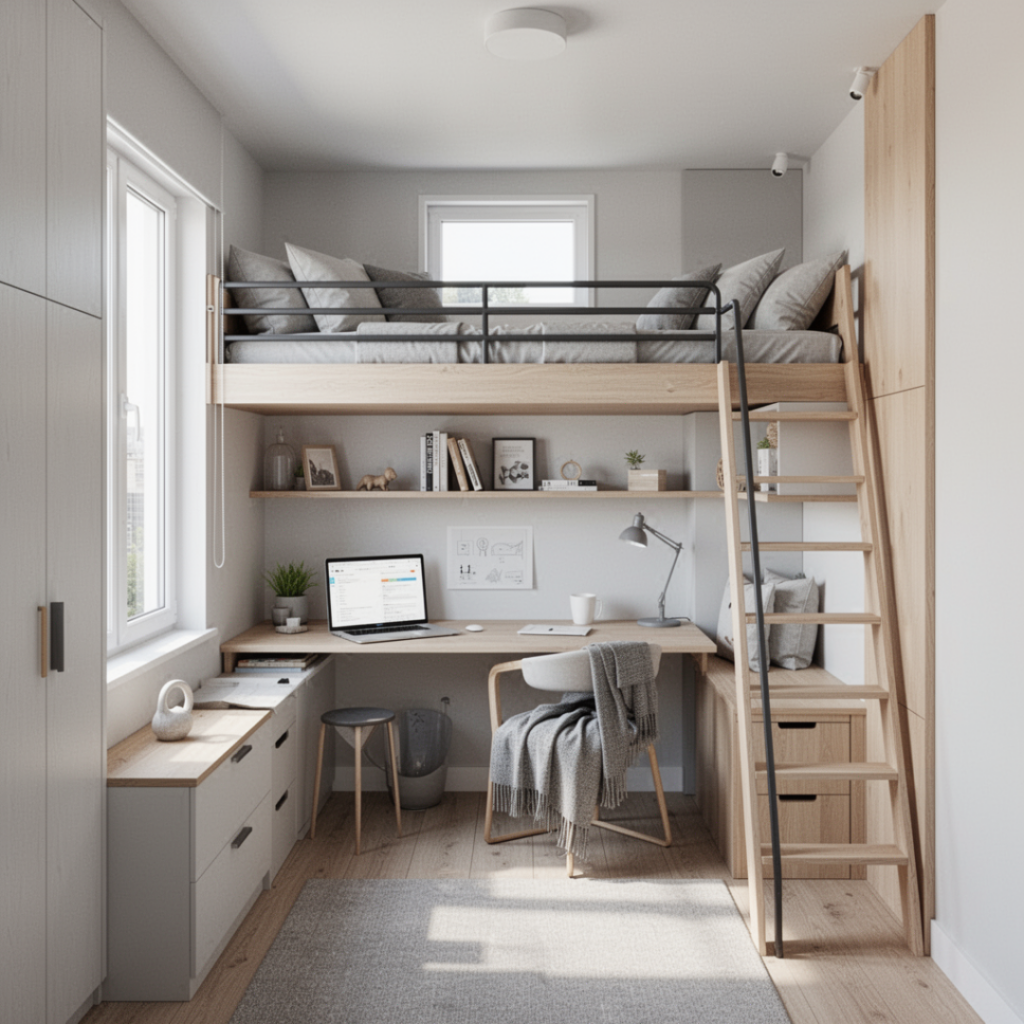
For studio apartment layouts where the bedroom and living area share the same open space, a loft bed is worth serious consideration. By elevating the sleeping area, you free up the entire footprint beneath it enough space for a desk, a small sofa, a wardrobe, or all three. It’s essentially a bunk bed where the bottom bunk is replaced by your entire living setup. Yes, it’s a bold choice, and yes, climbing a ladder every night takes some adjustment. But for renters who are truly short on space, a well-designed loft bed can make a studio apartment feel like it has an entirely separate bedroom.
If a full loft setup feels like too much, a raised bed frame with significant clearance underneath achieves a middle ground. Raise the bed high enough , with long legs or risers, and you create room underneath for rolling storage bins, baskets, or slim drawers without the full commitment of a loft structure. It’s a flexible, renter-friendly option that you can set up and take down without any installation.
Light-Enhancing Window Treatments
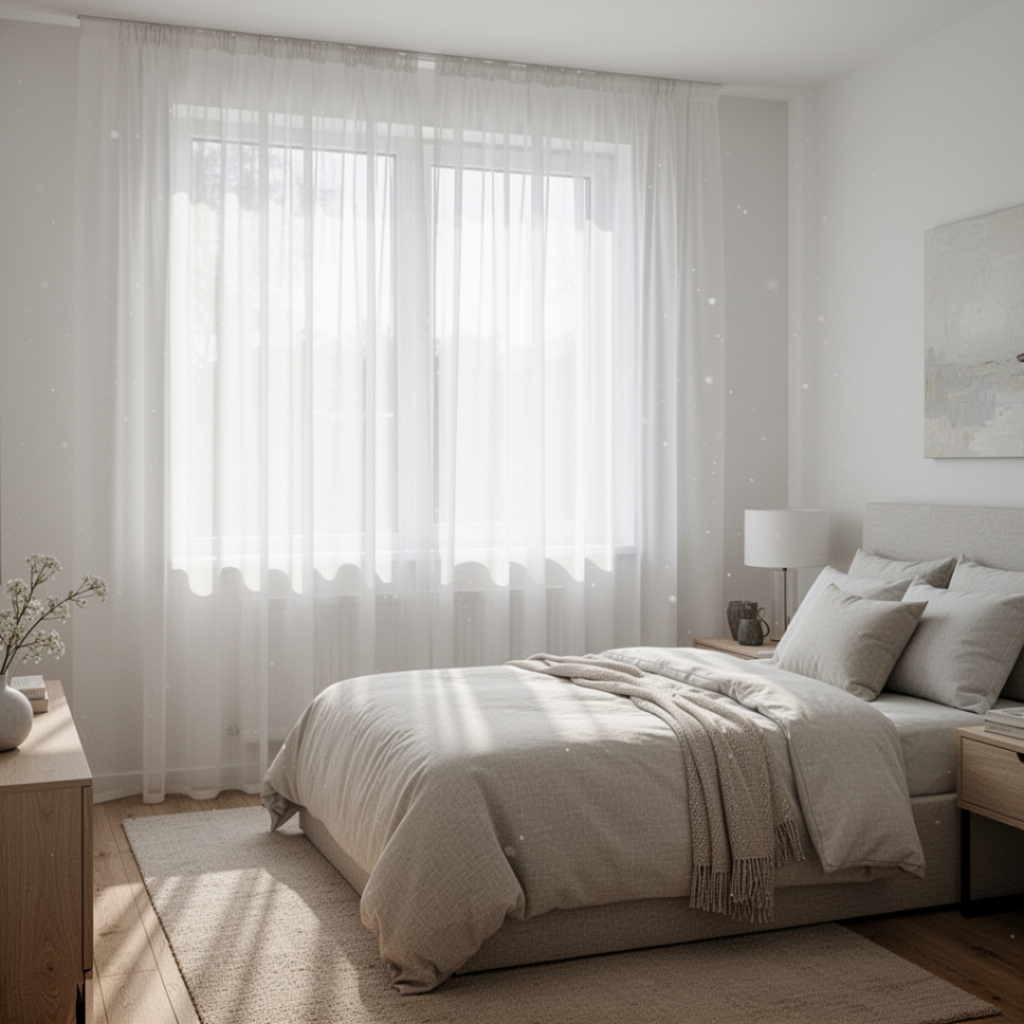
Natural light is one of the most powerful design tools available in any room , and in a small bedroom, it becomes even more critical. A well-lit room always feels larger than a dim one, which means your window treatments have a direct impact on how spacious your bedroom feels every single day.
The best choice for a small bedroom is almost always sheer curtains. Sheers allow natural light to filter through softly while still providing a layer of visual privacy during the day. They keep the room feeling bright and open without the heaviness of thick fabric panels, and they frame the window beautifully without overwhelming a small space. In a neutral white or ivory tone, sheer curtains practically disappear into the room in the best possible way.
Roman shades are another excellent option, particularly for renters who want something slightly more structured and polished. When raised, a Roman shade completely clears the window, allowing maximum light to flood the room. When lowered, it sits flat and neat against the window without the bulk of gathered curtain fabric. They’re especially practical in rooms where the window is close to furniture and there isn’t much clearance for curtain panels to hang.
What you want to avoid in a small bedroom is heavy drapes. Thick, heavily lined curtain panels absorb light, add visual weight to the walls, and make windows feel smaller and more contained. Even in a beautiful fabric, heavy drapes in a tiny bedroom tend to make the space feel heavier and more enclosed. Save those for a larger living room someday , in your small bedroom, keeping the window treatment light and minimal will always serve you better.
Smart Lighting Layers
Lighting in a small bedroom is about far more than just being able to see. The right lighting setup makes a room feel warmer, more intentional, and surprisingly more spacious. The wrong setup, a single overhead fixture casting flat light across every surface , makes even a well-designed room feel like an afterthought.
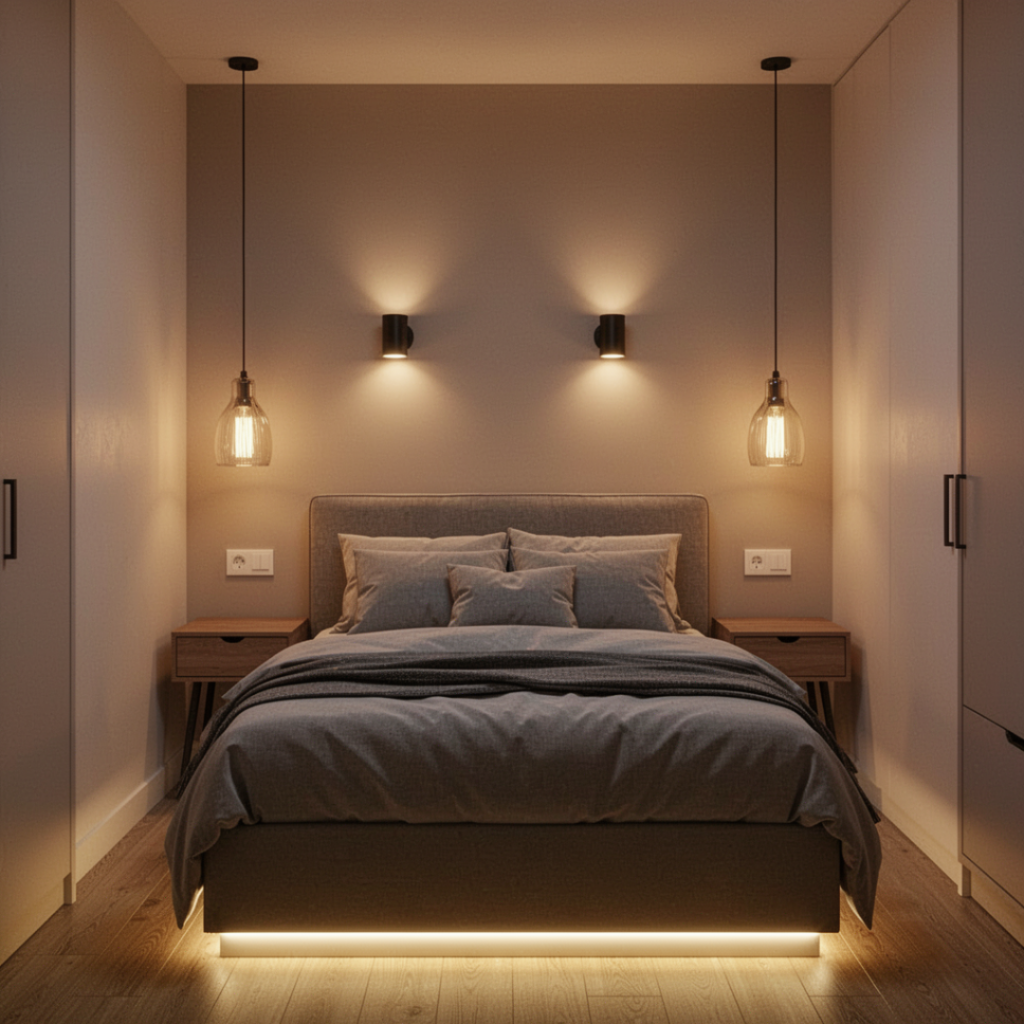
The most impactful single change you can make to your lighting setup is swapping table lamps for wall sconces. Table lamps sit on surfaces surfaces that are already precious real estate in a small bedroom. Wall sconces mount directly to the wall at the bedside, providing the same warm, directional light without occupying any surface space at all. They look more intentional, they free up your nightstand, and they create a layer of ambient light that feels far more sophisticated than a bare ceiling fixture.
LED strip lighting has evolved well beyond its college dorm origins and is now a genuinely elegant tool for small bedroom design. Installed along the underside of a floating shelf, behind a headboard, or along the base of a bed frame, LED strips create a soft, indirect glow that adds depth and dimension to the room. This kind of subtle backlighting makes walls and surfaces appear to recede slightly, which, in a small bedroom, creates a perception of more space. It’s also one of the easiest, most renter-friendly lighting upgrades available since it requires no wiring or installation.
Pendant lights hung at the bedside are another smart, space-saving alternative to table lamps. A single pendant hung from the ceiling beside the bed, or even a wall-mounted swing-arm pendant, gives you focused reading light and a design moment simultaneously. It draws the eye upward, adds vertical interest, and keeps your nightstand or shelf completely clear. For a small bedroom that you want to feel considered and intentional, pendant lighting does a lot of visual work for a relatively modest investment.
Space-Saving Closet Organization
A disorganized closet has a way of overflowing into the bedroom, which means your closet situation directly affects how your room looks and feels, even when the closet door is closed. Getting your closet organized properly is one of the most underrated small bedroom upgrades you can make, and it doesn’t require a major renovation.
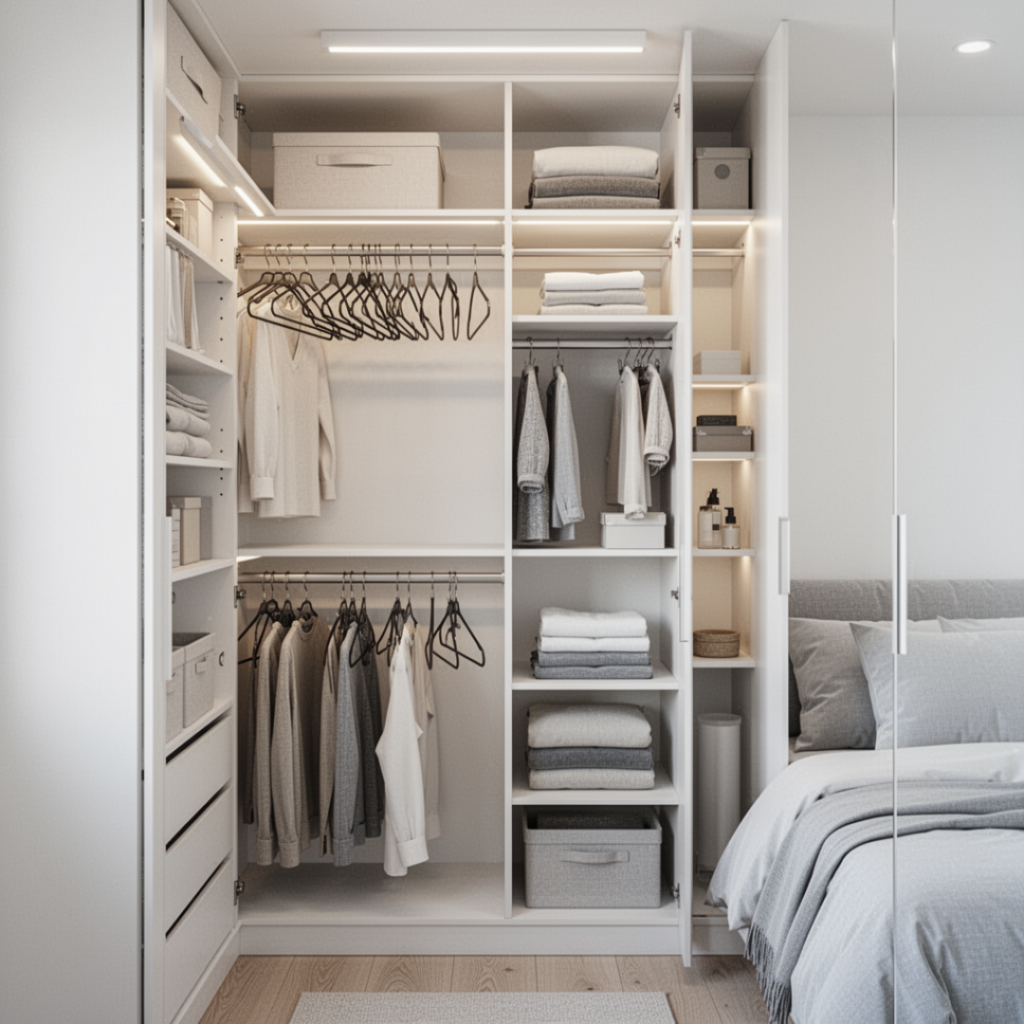
Start with something as simple as slim velvet hangers. Standard plastic hangers are bulky, uneven, and slide around constantly. Slim velvet hangers take up a fraction of the width, grip clothing so it doesn’t fall off, and give your closet rod the ability to hold significantly more items in the same space. Switching an entire closet from plastic to slim hangers can free up enough space to feel like you added an extra foot of rod length. It takes less than an hour and costs almost nothing.
Double hanging rods are the next level up. Most standard closets come with a single rod that runs the full width , which means the bottom half of the closet is usually an underutilized space. Adding a second rod below the first effectively doubles your hanging capacity in a single move. It works especially well for shorter items like jackets, shirts, and folded trousers, and it can be installed without any permanent modification to the closet itself, making it ideal for renters.
Finally, over-the-door organizers are one of the most space-efficient storage tools available for small bedroom closets. The back of a closet door is typically wasted space; an over-the-door organizer turns it into a storage surface for shoes, accessories, cleaning supplies, small folded items, or anything else that tends to pile up on shelves and floors. Look for slim-profile options that don’t prevent the door from closing properly, and you’ll have a fully functional storage system that didn’t cost you a single inch of floor space.
Creating a Visual Focal Point
In a small bedroom, there’s a temptation to go so minimal that the room ends up feeling bare and unfinished rather than intentional and designed. The solution to this is a focal point, one deliberate design moment that anchors the room visually and gives the eye somewhere to land when you walk through the door.
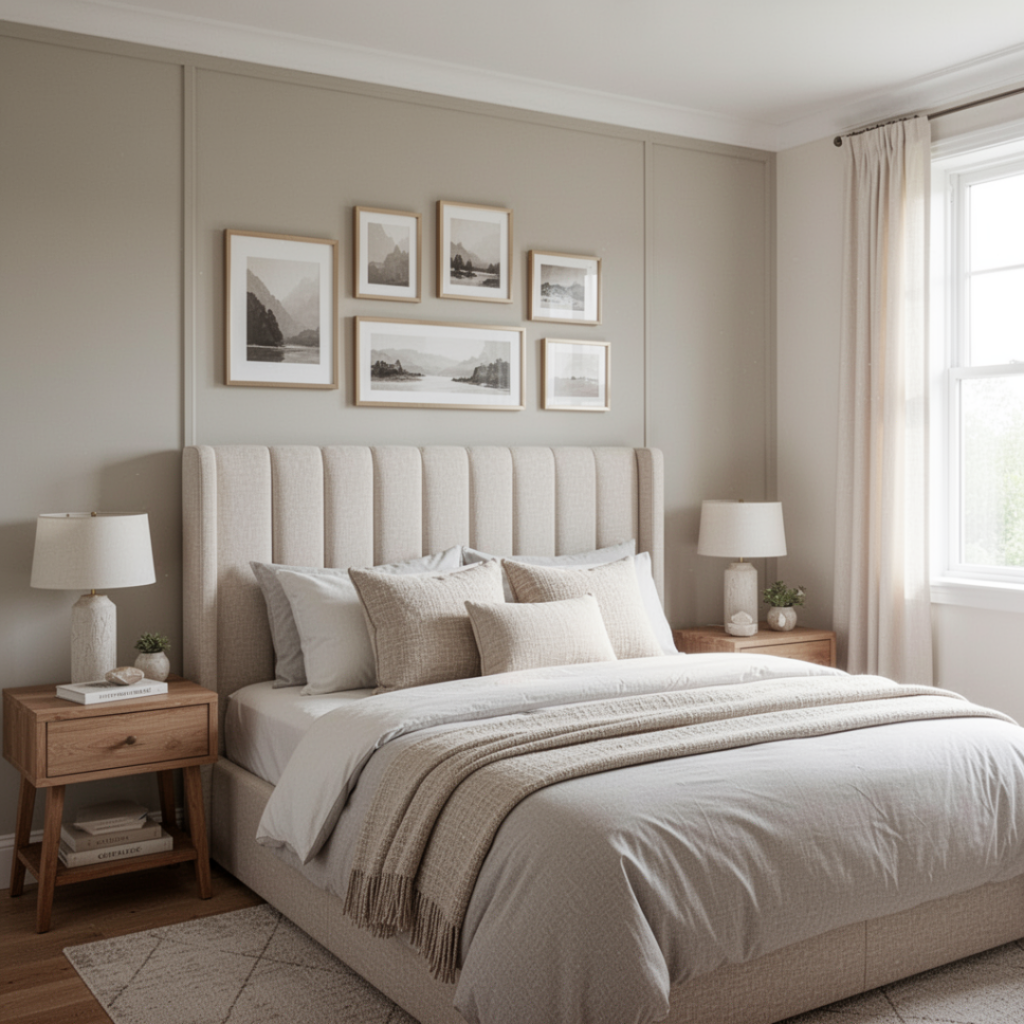
The most natural focal point in any bedroom is the headboard, and a statement headboard does this job beautifully. A tall, upholstered headboard in a rich texture , linen, velvet, or oucle creates a strong visual anchor behind the bed that makes the entire room feel more intentional. It doesn’t need to be enormous or elaborate. Even a simple, well-proportioned headboard in a color or texture that contrasts slightly with your wall will define the sleeping area and give the room a finished, designed quality that pulls everything together.
An accent wall is another effective focal point strategy, particularly if you’re renting a space with builder-beige walls and want to add personality without repainting the entire room. A single wall behind the bed, treated with removable wallpaper, a painted pattern, wood paneling, or even an arrangement of framed textiles, creates depth and visual interest without making the room feel heavy or busy. The key is to keep it contained to one wall and let the rest of the room stay calm and cohesive around it.
For a lighter touch, a simple gallery wall arrangement above the bed or on a blank accent wall can serve the same purpose. The emphasis here is on simple, a tightly arranged grouping of three to five frames in complementary sizes and matching or coordinating frames reads as a deliberate design choice rather than scattered decoration. It adds color, personality, and visual texture without taking up any floor space and without the commitment of paint or wallpaper.
Conclusion
A tiny bedroom doesn’t have to feel like a consolation prize. With the right layout, a thoughtful color palette, furniture that earns its keep, and a few smart visual tricks, a small space can become one of the most considered, comfortable, and genuinely beautiful rooms in your home.
Save this post, share it with a friend who’s staring down the same shoebox bedroom challenge, and come back to it when you’re ready for your next upgrade. Your tiny bedroom has more potential than you think, and now you have the roadmap to unlock it.
Frequently Asked Questions
What is the best color to make a small bedroom look bigger?
Whites, soft creams, and light grays are your best options. These tones reflect natural light and make walls feel like they’re pushing outward rather than closing in. For the most seamless effect, paint your walls and trim in similar shades to eliminate harsh visual boundaries that can make a small room feel even more confined.
What type of furniture works best in a tiny bedroom?
Multifunctional furniture is always your best bet in a small space. Look for storage beds with built-in drawers, ottomans with hidden compartments, and foldable desks that tuck away when not in use. The goal is to choose pieces that do more than one job so you’re getting the most value out of every square foot of floor space you have.
How do I make my small bedroom feel less cluttered without getting rid of everything?
Focus on your surfaces first. Keeping your dresser, nightstand, and windowsill as clear as possible instantly makes a room feel more open and intentional. Then, swap scattered
decorative items for just a few pieces you genuinely love, and give them space to stand out. Wall-mounted storage and under-bed organization do the rest, moving clutter off the floor and out of sight without forcing you to give anything up.