
A flat bedroom ceiling carries more design potential than most people use. With one continuous strip of LED light, that blank surface overhead turns into a sculptural feature that shapes the whole mood of the room.
Every modern bedroom ceiling design here uses strip lighting as the design itself, applied directly to a standard flat ceiling without tray construction or dropped panels. Each idea uses LED strip lights mounted in an aluminum channel and powered by a low-voltage driver. Warm white in the 2700K to 3000K range gives the most relaxing bedroom feel, and dimmable strips let the light adjust from bright reading mode to a low nightcap setting.
Here are nine ways to make a flat ceiling carry the entire design through strip lighting alone.

1. Full Perimeter Frame of Light
A continuous strip running along all four edges of the ceiling creates the cleanest version of indirect lighting you can install. The light bounces off the ceiling surface and washes down the upper walls in a soft, diffused glow.
The look depends on placement. Mount the strip about 4 to 6 inches from the wall on the ceiling itself, hidden behind a thin crown molding lip or slim aluminum channel facing upward. This conceals the light source and lets only the reflected light reach the eye.
Pick a warm white strip at 2700K for a bedroom that feels calm at night, and use a dimmer so the perimeter can drop to a low ambient setting before sleep. The closed rectangle of light pulls the ceiling slightly higher visually and frames the room without adding a single fixture.

2. Single Center Runway Strip
One strip running the full length of the ceiling, dead center above the bed, gives the room a strong architectural line without any structural work. The effect reads like a glowing spine pulling the eye from the headboard wall through to the foot of the room.
Choose a slim aluminum channel with a frosted diffuser cover, around 3/4 inch wide, mounted flush to the ceiling with construction adhesive or screws into joists. The diffuser softens the light into a smooth, continuous line.
This idea works best in rooms with a clearly defined sleeping zone, where the strip can run end to end uninterrupted. A 24V dimmable strip in 2700K warm white keeps the light comfortable for bedtime reading and quiet enough not to overpower a bedside lamp.

3. Off-Center Side Strip
Place a single strip along just one edge of the ceiling for the most minimal lighting design on this list. The light shifts asymmetrically toward one side of the room, creating a directional wash that lights one wall while leaving the rest of the ceiling matte.
Position the strip 6 to 8 inches off the wall along the side you want to highlight, often the headboard wall or the wall opposite the bed. The asymmetry feels intentional and modern.
For a calming nighttime feel, pair a 2700K warm white strip with a low-output dimmer setting. The single line of light reads almost like a hidden window high up in the room, a quiet element that does most of the work on its own.

4. Floating Rectangle Above the Bed
A rectangle of LED strip outlining the area directly above the bed turns the headboard zone into a defined sleeping pocket. The light frames the bed without touching the rest of the ceiling, which keeps the room feeling layered while staying restrained overhead.
Size the rectangle to match the bed footprint plus 6 inches of margin on each side. A queen bed at 60 by 80 inches works with a strip rectangle around 72 by 92 inches, mounted flat to the ceiling in aluminum channels with mitered corner joints.
Use a 24V warm white strip at 3000K and pair it with a smart dimmer so the rectangle can run bright in the evening, then drop to a low amber tone before sleep. The geometry of the rectangle gives the ceiling a clear focal point overhead while the rest of the surface stays clean.

5. Parallel Light Bands
Three or four straight strips running across the width of the ceiling, evenly spaced apart, create a rhythm of light bands overhead. The effect borrows from gallery and showroom lighting, scaled down for a residential bedroom feel.
Plan the spacing based on ceiling width. In a 12-foot-wide room, four parallel strips placed at roughly 30-inch intervals deliver balanced coverage without crowding the surface. Run the strips perpendicular to the bed for a clean visual rhythm, or parallel to the long wall for a subtler horizontal pull.
Each strip should sit inside its own slim aluminum channel with a diffuser cover so the line of light stays smooth and unbroken. Stick with one consistent color temperature across all bands. A 2700K to 3000K warm white range works well for a bedroom, and a single dimmer controlling every strip at once keeps the rhythm intact when brightness shifts.
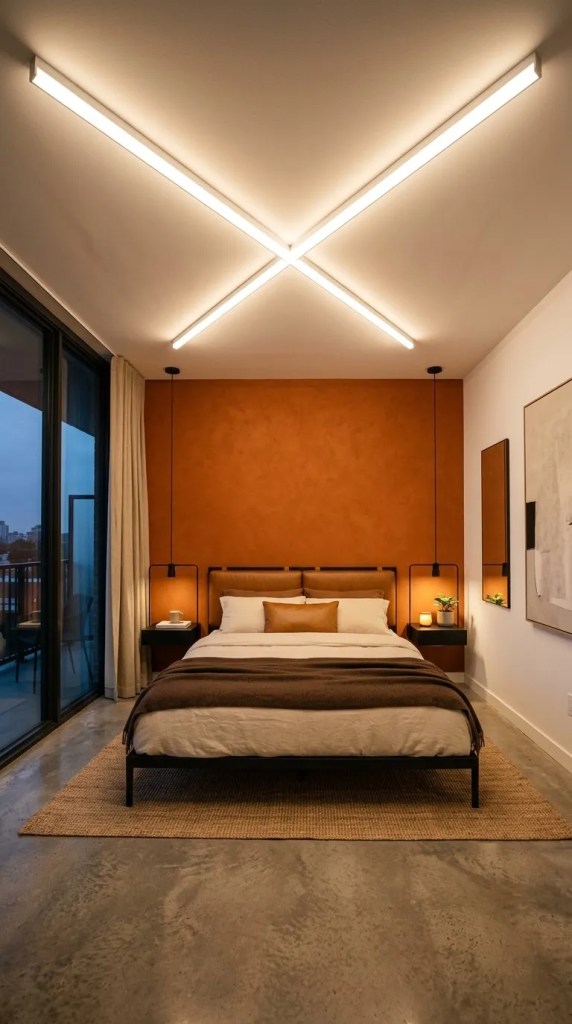
6. Crossed Strip Pattern
Two strips meeting at the center of the ceiling, forming an X or a plus sign, turns the surface into a geometric statement. The pattern divides the ceiling into four quadrants of light, with the intersection acting as the visual anchor of the room.
For a clean meeting point, use mitered aluminum channels cut at 45 degrees where the strips cross. A plus shape works well in square or near-square bedrooms, with one strip running the length of the room and one running the width. The X shape suits longer rectangular rooms, where diagonal lines fill the space more evenly.
Run a 24V strip at 2700K through both channels for visual consistency. Wire both lines to a single dimmer so the entire pattern brightens and dims as one piece. The result is sculptural without taking up any wall or floor space.

7. Curved S-Wave Strip
Most strip lighting follows straight lines, which is part of what makes a curved version stand out. A single strip bent into a soft S-curve across the ceiling reads as a flowing brushstroke of light against an otherwise plain surface.
Use a flexible aluminum channel or a bendable silicone-encased LED strip rated for tight curves. The minimum bend radius matters here: most flexible LED channels handle a 4 to 6 inch radius before the strip starts to warp or fail. Sketch the curve on the ceiling with painter’s tape before mounting to confirm the shape works in the room.
A 2700K strip with a frosted diffuser keeps the wave reading as one smooth line. This idea suits bedrooms with a clean, contemporary bedding palette, where the curved line of light becomes the only decorative gesture on the ceiling.

8. Circular Halo of Light
A closed circle of strip light at the center of the ceiling acts like a hovering halo over the room. The round shape softens an otherwise rectangular space and gives the ceiling a single, sculptural focal point.
Most flexible LED channels can bend into circles with diameters of 24 inches and up. A 36 to 48 inch ring sits well above a queen bed in a standard 10 by 12 foot bedroom, registering clearly from across the room while keeping its proportions in check. Use a continuous flexible channel rather than joined segments to keep the circle reading as one unbroken loop.
A 2700K strip with a fine diffuser cover gives the halo a continuous glow with no visible LED dots. Pair it with a dimmer for low-level nighttime use. The circle works particularly well in rooms with otherwise minimal decor, where the geometric shape gets to do all the visual talking.

9. Glowing Ring Around the Central Light Fixture
A strip light formed into a ring that surrounds your existing pendant or flush mount turns one ceiling fixture into a layered lighting moment. The strip adds a second source of indirect light at the ceiling plane while the original fixture continues to do its job below.
Measure the diameter of your existing fixture and add 12 to 18 inches of clearance on every side. A 14 inch flush mount paired with a 38 to 50 inch strip ring gives enough breathing room so the halo reads as a separate element. Use a flexible aluminum channel curved into the circle, mounted directly to the ceiling around the base of the fixture.
Match the strip’s color temperature to the fixture’s bulb so the two light sources blend together. A 2700K strip works with most warm-bulb fixtures. Wire the ring to its own switch or smart dimmer, which lets the strip serve as a soft ambient layer when the main fixture stays off.
Frequently Asked Questions
What color temperature LED strip is best for a bedroom ceiling?
Warm white in the 2700K to 3000K range is the right pick for a bedroom. This color temperature produces a soft, amber-leaning glow that signals the body to relax and supports natural melatonin production before sleep.
Cooler temperatures of 4000K and above push toward daylight tones, which feel clinical overhead in a bedroom. Save those higher color temperatures for offices and kitchens, where the brighter effect suits the function of the space. If you want the option to shift the mood, use tunable white strips that adjust anywhere from 2200K to 5000K through a smart controller.
How do you hide LED strip lights on a bedroom ceiling?
The cleanest way to hide a ceiling LED strip is to mount it inside an aluminum channel with a frosted diffuser cover, which conceals the individual LED dots and reflects only the soft line of light.
For a fully hidden source, position the strip behind a crown molding lip about 4 to 6 inches from the wall, with the LEDs facing upward toward the ceiling. The light bounces off the ceiling surface and the strip itself stays invisible from below. Another approach is a recessed channel built flush into the ceiling drywall, which leaves no visible profile at all. Painter’s tape works for mocking up the placement before committing to a permanent mount.
Do strip lights make a bedroom ceiling look taller?
Yes, perimeter strip lighting pushes the ceiling visually higher by about 6 to 12 inches in perceived height. The effect comes from the same indirect lighting principle behind cove lighting: when light washes upward and outward across the ceiling surface, the eye reads that softly lit plane as receding into space.
Centered strips and floating rectangles create a different effect, breaking up the flatness of a low ceiling so the room feels less enclosed.
Are LED strip lights safe to leave on overnight?
Most LED strip lights sold today are designed for extended runtime and stay cool enough during operation that they pose no fire risk when left on overnight. The diodes themselves typically run at 30 to 40 degrees Celsius (around 86 to 104 degrees Fahrenheit), well below ignition temperatures.
Two conditions matter for safety. The strip should be mounted in an aluminum channel that dissipates heat, and the power supply or driver should match the strip’s wattage rating. A mismatched driver causes most LED strip failures, including overheating.
If you want to leave the strip on as a nightlight, dim it to 10 to 20 percent output. The lower current extends lifespan and reduces any residual heat buildup to almost nothing.
How long do LED strip lights last on a ceiling?
LED strip lights last between 30,000 and 50,000 hours of runtime when sourced from a reliable manufacturer. That translates to about 17 to 25 years of use if the strip runs 6 hours per day. The lifespan depends most on heat management, with driver quality and dimming frequency playing secondary roles.
Strips mounted in aluminum channels last longer than bare adhesive-mount strips because the channel acts as a heat sink. Running the strip at 70 to 80 percent of maximum brightness extends life significantly, since LED diodes degrade faster at peak power.
Can you install ceiling LED strip lights without rewiring?
Yes, plug-in LED strip kits work without any rewiring and connect to a standard wall outlet through a low-voltage driver. The strip itself attaches to the ceiling with 3M adhesive backing or an aluminum mounting channel. The driver converts 120V household current to the 12V or 24V DC that the strip needs.
The trade-off is a visible power cord running from the strip down to the outlet. For a cleaner finish, route the cord through a paintable cord cover or run it down the corner of the room where it draws less attention. Hardwired installation hides the wiring inside the wall but requires an electrician and a switched ceiling junction box, which most bedrooms have available from a previous ceiling light fixture.


