
A stone fireplace in the corner of a log cabin hands you the best seat in the house and one of the hardest decorating puzzles. Log walls, wood floors, and a timber ceiling already fill the room with one material, which leaves the stone and the TV screen to carry all the contrast. And they have to share a single corner.
This guide works in order. Placement comes first, including how to drill into rock safely and what the fire’s heat means for your screen. Styling the stone comes second. The last section pulls timber, rock, and a black screen together so the room reads as one planned design.
If your fireplace sits in a corner but your walls are drywall, the guide to decorating a living room with a corner fireplace and TV covers that setup. Everything below is written for the cabin.
Solve the TV Placement First

1. Mount the TV on the Stone the Right Way
Start by figuring out what kind of stone you have, because the method changes with it. Full-thickness stone takes masonry anchors driven straight into the rock with a hammer drill. Thin stone veneer cannot hold a TV on its own, so the answer there is long lag bolts that pass through the veneer and bite into the wall studs behind it.
Run a heat test before any drilling. Tape a thermometer to the spot where the screen will hang, burn the fire for a full hour, then check the reading. Most TV manuals set the safe ceiling near 100°F, so a higher number means you need a deeper mantel below the screen or a different spot entirely.
For position, keep a wall-mounted TV 4 to 6 inches above the mantel and its center under 70 inches from the floor. Hide the cords in a slim channel run along a grout line, or use a wireless HDMI kit so the only line left to conceal is power.

2. Use a Pull-Down Mount to Beat the Tall Cabin Mantel
Cabin fireplaces tend to run tall. The stone climbs, the mantel lands high, and a fixed screen above it forces everyone to watch with their chins up. A pull-down mantel mount solves the height: the arm swings the TV down and forward to seated eye level for viewing, then folds it back flat against the stone when the fire takes over.
Buy a model rated for your screen’s size and weight, and look for one with a heat-sensing handle. That feature warns you when the air above the firebox climbs too high for the electronics, which matters more on a wood-burning unit than on gas.
3. Angle the TV on the Log Wall Beside the Fire
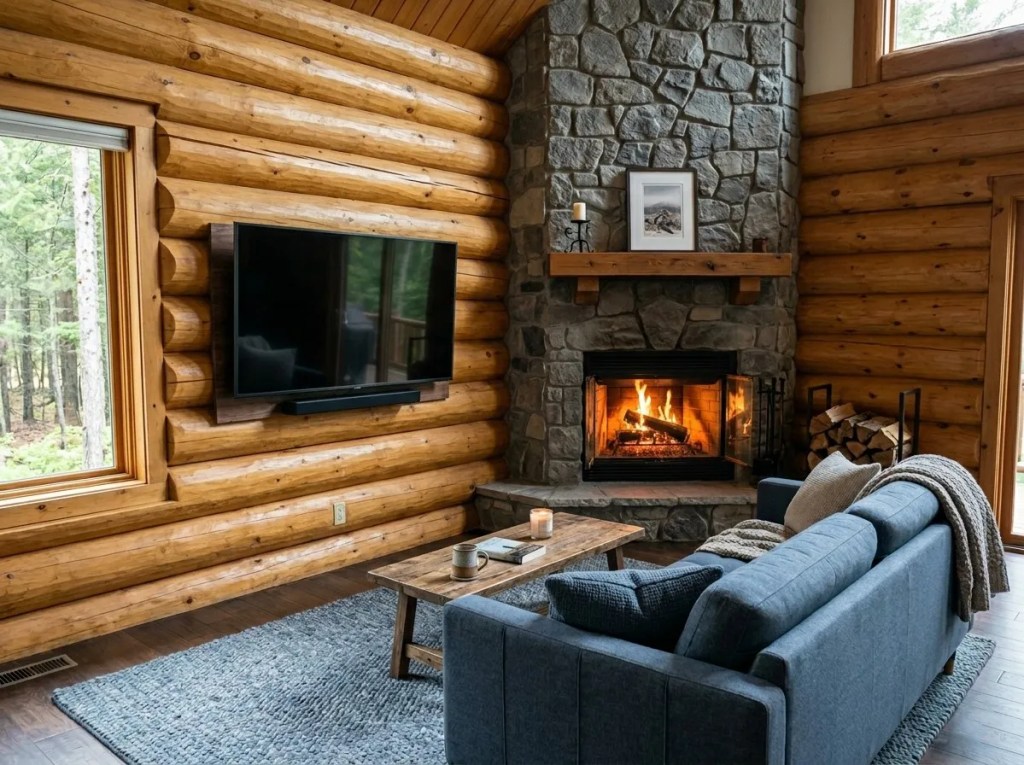
Skipping the stone is a legitimate move. The log wall that meets the fireplace takes a mount with far less drama, since lag screws sink into solid timber without special anchors. Hang the screen there, angled a few degrees toward the seating, and you get a viewing triangle: fire in the corner, screen beside it, sofa facing both.
Round logs add one extra step. The curved face will rock a flat bracket, so screw a flat wood mounting board across two log courses first, then bolt the TV mount to the board. Stain the board to match the wall and it disappears.
Leave slack in the cables too. Log walls shift slightly through the year as the timber takes on and releases moisture, and a cord pulled tight is the first casualty.

4. Set It on a Low Console Tucked Against the Hearth
No drilling at all works when the cabin is a rental or the stone is too pretty to touch. Place a low media console on the wall nearest the corner and let the screen stand on top. A console 20 to 24 inches tall puts the center of most screens near seated eye level, which beats almost every over-mantel position for comfort.
Choose the console like it belongs to the fireplace. A top in the same wood tone as the mantel ties the two together, and black iron legs or hardware nod to the fire tools on the hearth. Pull the unit a few inches off the log wall so the bottom log’s curve cannot tip it forward.

5. Hide the Screen Behind Cabin-Style Doors or Frame Art
Some owners want the fire alone in charge of the room until movie night. Sliding barn doors or bifold panels mounted over the screen do that, and they suit a log cabin better than any other house style. Some cabin builders even swap carved or painted door panels with the seasons, which turns the TV cover into rotating wall art.
The lower-effort version is a frame-style TV that displays artwork while idle. Load it with a landscape painting or a vintage trail map; the real fire is already six feet away. A matte-screen model also cuts the glare that big cabin windows throw across glossy panels.
Style the Stone Around the Screen

6. Top the Stone with One Chunky Wood Beam Mantel
A corner stone fireplace usually offers one flat surface, and that is the mantel. Give the job to a single thick beam, hand-hewn or live edge and at least 4 inches thick, so it holds its own against the mass of the rock below. Thin painted shelves vanish against stacked stone.
Style the top sparse. Three pieces at most: a storm lantern, a short stack of hardcovers, one tall item like dried branches in a stoneware crock. The stone needs breathing room between objects, and the screen above or beside the mantel already fills its share of the corner.

7. Turn the Raised Stone Hearth into a Display Ledge
Many corner units sit on a raised hearth that wraps both exposed sides, and that ledge is the most underused surface in cabin living rooms. Stack split firewood in a tight column at one end. Park a cast iron kettle or an oversized lantern at the other.
Keep the middle clear. The firebox needs open space in front of it, and anything that can burn belongs well back from the opening. A hearth around 18 inches high also doubles as guest seating when the room fills up, one more reason the center stays empty.

8. Rake Light Across the Stone at Night
Stacked stone earns its place through texture, and texture only shows when light crosses it at an angle. Aim two slim picture lights or downlights at the chimney breast so the beam skims down the surface and throws every ledge into shadow. Uplights tucked at the hearth corners do the same job from below.
Stick with warm bulbs around 2700K, close to the color of firelight, because cooler daylight bulbs flatten the relief you paid for. An LED strip under the mantel lip washes the lower stone and doubles as bias lighting near the screen, easing the contrast of a bright picture in a dark cabin.

9. Let Floor-to-Ceiling Stone Above the TV Stay Bare
When a corner stone fireplace climbs floor to ceiling, the urge is to fill the space above the screen with art or antlers. Resist it. That column of rock under a cathedral ceiling is already the largest piece of art in the cabin, and small frames pinned to it read like postage stamps on a monument.
Bareness also spares the stone. Every hanging means another anchor hole, and rock does not patch the way drywall does.
If the chase still feels empty in a tall great room, lean one oversized piece on the mantel or hearth, a 40-inch round mirror or a weathered orchard ladder, and leave the vertical stone above it untouched.
Balance the Logs, the Stone, and the Screen

10. Soften Wood-on-Wood with Layered Textiles
Stone, logs, and screen are all hard surfaces, so the room needs softness in volume. Start with a large area rug, 8 by 10 feet or bigger, placed so at least the front legs of every seat land on it. The rug breaks the run of wood floor and gives the seating zone its own ground.
Then layer upward. A sheepskin over the leather chair nearest the hearth, a wool plaid throw on the sofa arm, linen and canvas cushions in mixed sizes. Each soft texture makes the stacked stone look rougher and the logs look warmer, which is the contrast this room lives on.

11. Angle the Furniture to the Corner Diagonal
A corner fireplace pulls the room’s focus off its square axis, so let the furniture follow. Float the sofa to face the corner straight on, around 8 feet back from a 65-inch screen, and angle two chairs off its ends to close a conversation triangle. Everyone gets the fire, the TV, and each other without turning.
Leave about 3 feet of walking room behind the floated sofa, and keep large pieces off the log walls so the timber stays visible as a backdrop. Corner focal points create some of the trickiest layouts in any home, and the guide to arranging furniture in an awkward living room layout goes deeper on those puzzles.

12. Pull Your Color Palette from the Stone Itself
The fastest way out of an all-brown room is to let the stone pick your colors. Look closely at the rock. Most fieldstone and stacked stone carries gray, tan, rust, and sometimes a cool blue-green vein. Choose two of those tones and repeat them in cushions, throws, pottery, and one larger piece like an armchair.
Sage green with rust reads warm and grounded against gray stone. Cream with clay tones suits tan river rock. Either way, the palette already exists in the corner, so every textile you add looks like it was always meant to be there.

13. Repeat the Screen’s Black Frame Around the Room
A TV stops looking like an intruder the moment its color shows up elsewhere. Matte black is the easiest thread to pull: iron fire tools on the hearth, black sconces raking the stone, a black metal floor lamp behind the reading chair, black pulls on the media console.
Three or four black accents spread through the room turn the screen into one member of a family. In cabins with black window frames, the effect grows even stronger, since the TV joins a line that already runs through the architecture.
Conclusion
A corner stone fireplace with a TV asks for decisions in the right order. Settle the screen’s position first, since heat, stone type, and viewing height rule out half the options before style enters the picture. Then dress the three stone surfaces you own: the mantel, the hearth, and the chase. Finish by letting textiles, color, and black accents balance the timber surrounding it all.
Work that sequence and the corner becomes the reason guests pick the seat facing it.
Frequently Asked Questions
Is it safe to mount a TV above a stone fireplace in a log cabin?
Yes, once the heat checks out. Tape a thermometer to the spot where the screen will hang, run the fire for a full hour, and compare the reading to the limit in your TV manual, which sits near 100°F for most models. A deep mantel below the screen adds clearance and deflects rising heat, and a wood-burning firebox calls for more caution than gas or electric.
How do you mount a TV on uneven stacked stone?
Pick a mount with a wide wall plate so it spans several stones rather than balancing on one. Drill with a hammer drill and masonry anchors if the stone is full thickness, or drive long lag bolts through veneer into the studs behind it. Level the plate with washers behind the low spots and check it with a level before tightening anything down.
How high should the TV sit above the mantel?
Keep the screen 4 to 6 inches above the mantel and its center under 70 inches from the floor. When tall stone pushes it higher than that, a pull-down mantel mount brings the picture back to seated eye level whenever you watch.
Where can the TV go if I don’t want to drill into the stone?
The log wall beside the fireplace takes a mount with plain lag screws, since the timber is solid wood. A low media console near the corner works with zero drilling at all, and a 20 to 24 inch height lands the screen close to seated eye level.
What colors work with a stone fireplace and log walls?
Pull two tones straight from the stone: sage or moss green, rust, clay, cream, or soft gray all show up in common fieldstone and stacked stone. Repeat them in cushions, throws, and pottery so the palette feels built in. Matte black accents round it out by tying the screen and the iron hardware together.
How do I stop the TV from looking out of place in a rustic room?
Repeat its matte black finish in three or four spots around the room, like fire tools, sconces, and lamp bases. A frame-style model showing artwork while idle helps too, and sliding doors or bifold panels remove it from view entirely. Mounted at a height that relates to the mantel, the screen reads as part of the fireplace wall rather than a gadget on top of it.


